PhotorActVine: Exploring Entomopathogenic Bacteria for Grapevine Protection
- studiare
- terza missione
Abstract
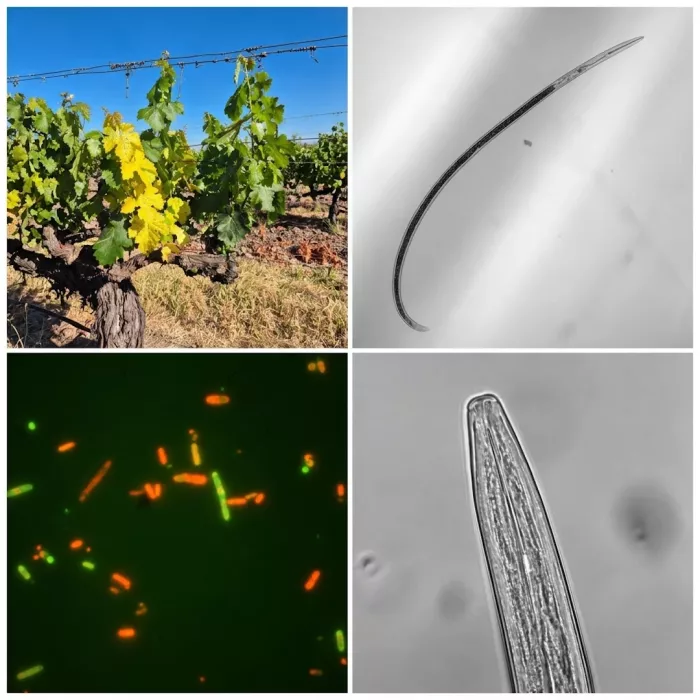
Grapevine health faces global challenges that threaten the productivity and sustainability of viticulture. Fungal pathogens, phytoplasmas, viruses, and pests affect grapevines both above and below ground. Among these threats, the plant-parasitic nematode Xiphinema index poses a particular challenge by damaging roots and transmitting Grapevine fanleaf virus (GFLV), which causes leaf deformation, reduced vine vigor and substantial yield losses. The need to reduce reliance on chemical nematicides makes alternative control strategies a shared priority across wine-growing regions worldwide. PhotorActVine, a research project funded through a Marie Skłodowska-Curie Global Fellowship, investigates the potential of Photorhabdus and Xenorhabdus, the symbiotic bacteria of entomopathogenic nematodes, to manage plant-parasitic nematodes, particularly X. index, with the aim of reducing root damage and limiting virus transmission. This seminar will review current knowledge and recent advances in the application of these bacteria, presenting experimental evidence on how nematicidal activity varies across bacterial strains and target species. It will also examine their poorly understood ecology outside the nematode–insect association and the questions this raises about plantbacterial interactions. Finally, this presentation will showcase collaborative research with the Fruit and Molecular Phytopathology Laboratory at the University of Chile, illustrating broader applications of Xenorhabdus and Photorhabdus secondary metabolites against Botrytis cinerea isolates with contrasting fungicide resistance profiles. Taken together, the findings on plant-parasitic nematodes and B. cinerea will highlight the importance of bacterial strain, target organism and application context in shaping efficacy, emphasizing the need to incorporate target diversity into the development of biological control tools.
The speaker
Dr. Ignacio Vicente Díez is a Marie Skłodowska-Curie Postdoctoral Fellow at the University of Trento, currently undertaking the outgoing phase of his Global Fellowship at the University of Chile. He holds a degree in Biotechnology from the University of Lleida (Spain), a master’s degree in Environmental Agrobiology from the University of the Basque Country and the Public University of Navarre (Spain), and a PhD from the University of La Rioja (Spain). He conducted his doctoral research at the Institute of Grapevine and Wine Sciences (ICVV, Spain) under the supervision of Prof. Raquel Campos-Herrera and Prof. Alícia Pou, investigating entomopathogenic nematode symbiotic bacteria for vineyard pest and disease management. His research focuses on beneficial microorganisms and their metabolites for crop protection. Through PhotorActVine, supervised by Prof. Michele Perazzolli (UNITN, Italy) and Prof. Alan Zamorano (UCh, Chile), he is extending this work to bacterial adaptation and grapevine–microbe interactions.