Popular Mobilisation and International Solidarity: Reflections on the Anti-Apartheid Movement and Palestine Solidarity
Abstract
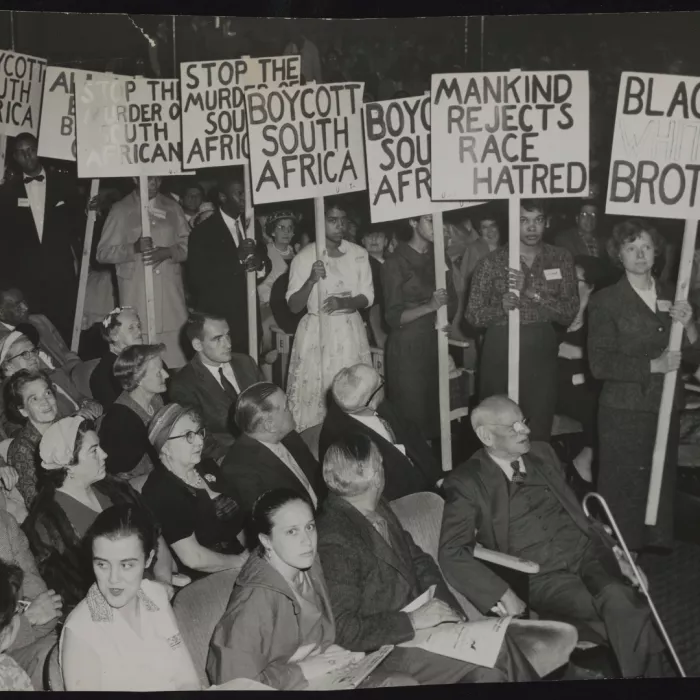
The South African government’s decision to take Israel to the International Court of Justice on a charge of genocide has placed the country at the forefront of international solidarity in support of Palestinians’ struggle for freedom. Its role has been augmented by the Hague Group, which seemingly represents a global network of governments acting in concert against existing global powers. Simultaneously, popular mobilisation in support of Palestinians since 2023 arguably represents the most significant expression of international solidarity in a generation. Both popular movements and governments routinely invoke the solidarity campaigns against Apartheid South Africa as the inspiration for their stand against Israel. The Boycott, Divestment and Sanctions campaign of the 1970s and 1980s is understood as a critical pillar in the struggle that ended apartheid. The intention, or hope, is for the current BDS campaign to make a similar contribution. This presentation will examine the significance of this historical reference and highlight the complex interaction between popular mobilisation and the actions of governments. In particular, it will demonstrate the centrality of grassroots movements in sustaining meaningful solidarity by examining key campaigns in the Anti-Apartheid Movement, such as economic, academic/cultural and sports boycotts. The aim is to draw a few salient lessons from the Anti-Apartheid Movement, the exemplar of international solidarity in the late 20 th century, for the contemporary global Palestine solidarity movement. In so doing, key similarities and dissimilarities between these solidarity movements will be considered. These reflections are offered from the vantage point of the current Palestine solidarity movement in South Africa.
Biographical note
Noor Nieftagodien, South African Research Chair in Local Histories and Head of the History Workshop at Wits, is a leading historian of popular struggles, youth politics, and local histories. He has co-authored major works on Alexandra, Ekurhuleni, Kathorus, and Soweto, and collaborates internationally on comparative research. Through the History Workshop, he leads community-engaged projects producing documentaries, exhibitions, and national conferences. His work bridges scholarship and activism, including writings on contemporary radical movements. He serves on multiple boards such as SAHA, CUBES, SWOP and SERI, and continues the activist commitments that shaped him since the 1980s.
Speaker
Noor Nieftagodien, University of the Witwatersrand
Chair
Sara de Simone, Università di Trento