From waste to wellness: black soldier fly (Hermetia illucens) as a functional feed to enhance animal gut health
- ricerca
- terza missione
Abstract
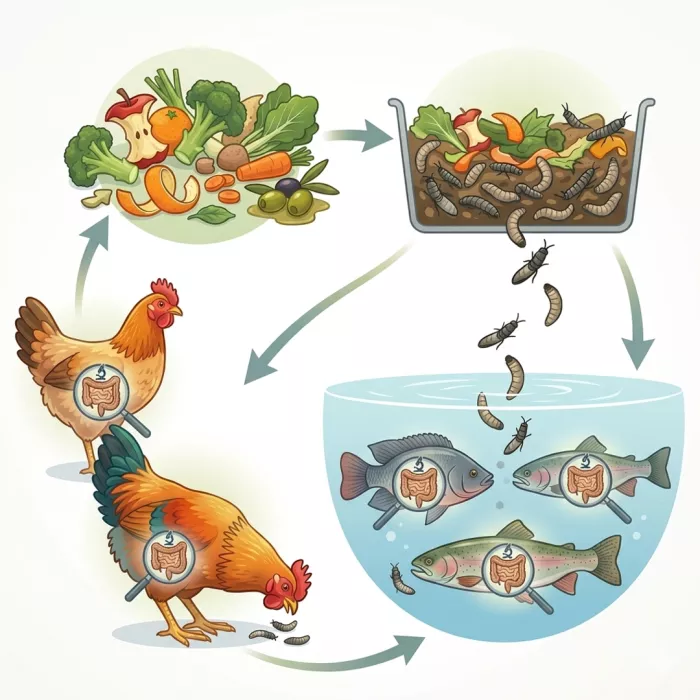
The seminar will explore the concept of gut health in animal species, describing the different assessment methods (histomorphometry, mucin expression, local immune responses, and microbiota composition) with a multidisciplinary approach stressing its importance in nutrition studies aimed at evaluating the effects of new ingredients. Among the latter, insect-derived products—including meals, oils, and live larvae—are emerging as promising and innovative ingredients in animal nutrition. In particular, the black soldier fly (Hermetia illucens, HI) stands out as one of the most suitable species for feed applications, thanks to its valuable nutritional profile and its chitin content, which has been associated with immunostimulatory and antimicrobial effects.
This seminar brings together ten years of research conducted by prof. Capucchio’s team on the impact of insect-based feed ingredients on gut health in food-producing animals. Although insects represent a highly promising functional ingredient in monogastric nutrition, further research is needed to clarify the mechanisms of action of their bioactive compounds and optimize their use. In this context, the seminar will present the ongoing PRIMA OLIWA project focused on the valorization of the olive oil waste and by-products in insect rearing and the evaluation of the molecular pathways of bioactive compounds of HI through in vitro and in vivo investigations.
Speaker
Prof. Maria Teresa Capucchio is an associate professor at the Department of Veterinary Sciences, University of Turin, Italy. She delivers undergraduate courses in Veterinary Pathology (gastro-intestinal pathology, neuropathology, and pathology of muscle); pathology of pigs and comparative gastro-intestinal pathology. At the graduate level, she has contributed to master’s and PhD programs with courses and seminars on host-pathogen interaction, mainly focused on the gastrointestinal pathology and the pathology of biological agents. Prof. Capucchio is actively engaged in research and academic mentorship, supervising undergraduate and graduate theses for both national and international students. In terms of university administration, it includes the coordination of the PhD in Veterinary Sciences since 2020 and the coordination of the Biosecurity Committee of the Department from November 2018 to December 2020.
In research, her efforts focus on the evaluation of gut health/systemic morphological alterations following the use of new dietary supplements in livestock and pets (natural antioxidants, immunomodulators, milk glycoproteins; antimicrobial peptides, probiotics, insects), and host-pathogens interaction applying morphometry, histopathology, immunohistochemistry, and molecular biology techniques. Prof. Capucchio has made significant strides in the veterinary pathology and nutritional pathology through her contributions to national and international conferences, impactful publications in prestigious journals indexed in Web of Science and Scopus (H index 37), and leadership in national and international research projects, demonstrating sustained scientific engagement and dissemination.